
Elephant foot yam or suran/surnu is grown widely at my native. This root is used in a wide variety of dishes in Konkani cooking. We used to grow them a lot in our backyard. I still remember my grandfather used to take out these roots carefully and wash them and store to be used throughout the year.
I never had the courage to use this root in my cooking, mainly because some of the roots cause strong itching to hands after cutting them. So aayi applies thick ‘tamarind juice’ to hand after cutting them to overcome the itching (apply thick juice and leave it for 5mins then wash hands).
I had no idea how to pick up these roots or what they are called here. When Aruna told me about ‘yam’, I searched for them in Chinese market, but they looked very different than the one we got in India. It was white from inside unlike the suran which is reddish in color. Still when I prepared this traditional dish, it tasted great. Recently I saw ‘frozen suran’ in Indian store. So next time, I will try this dish with authentic suran :).
Raw jackfruit(kadgi or chakko) koot is also prepared on similar lines. I will post the recipe seperately.
Ingredients: Suran (cut into tiny pieces) 1/2 cup Coconut 1 cup Mustard seeds 1 tea spn Methi (fenugreek) seeds 1/4 tea spn Asafoetida a pinch Red chilies 4-5 oil 1 and 1/2 tea spns Curry leaves 4-5 Tamarind 1/2 tea spn Salt
Method: Mix 1 tea spn of salt with the pieces and leave them for 30mins. Squeeze out the water off suran pieces and wash them in water for once or twice. Heat 1/2 tea spn of oil and fry them on a low flame till they become almost black and crunchy.

Heat 1/2 tea spn of oil and add 1/2 tea spn mustard. When it starts popping, add methi seeds and asafoetida. Grind this with coconut, red chilies((fry the chilies in oil along with mustard and methi, if they have become soft. This will help in grinding them to smooth paste) and tamarind to chutney consistency. Add salt (suran pieces will retain some salt from the previous step, so take care not to add too much salt).

Heat remaining oil and add mustard seeds. When they start popping up, add curry leaves. Add this seasoning to the chutney.

Just before serving, add the fried suran pieces to the chutney. (Take care not to add hot suran pieces to chutney. It spoils the chutney soon. So cool the pieces to room temperature before mixing).
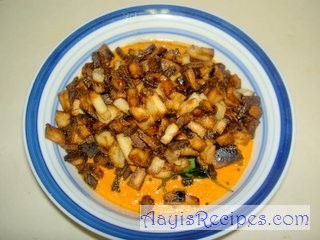
Serves : 3 Preparation time : 20mins

Today is the auspicious day of Srikrishna Janmashtami , a hindu festival celebrating the birth of lord Krishna . This is my favourite festival among all hindu festivals. Here is how we celebrate it.
Few people keep a fast (without food and water) on this day. But at my home, we used to eat a light fasting lunch. The main celebrations start in the night. At our native, this pooja is performed only in few houses and in temples. Men gather at a place to do the pooja.
The poojari (called as ‘bhatmam’ in Konkani) goes to these places and lends them small saligram and a statue of Bala-Krishna (child krishna, The statue looks similar to the above picture). Bhatmam does the initial pooja to both saligram and statue and prepares the ‘Panchamrit/panchamritam’, offering prepared by mixing ‘panch’ – 5, amrit – immortal nectar. The main ingredients here are milk, sugar, yogurt(curd), honey and jaggery ( molasses ).
Then the men at home/temple carry on with the remaining procedures. They decorate god with lotus and other flowers. Then one of the men take the lead and read 1000 names of lord Krishna (Vishnu sahasranama), others follow him, with each name, men offer one tulsi dala (two leaves connected together) to lord. After 500 names one pooja is performed and after all the names are chanted, a offering of food followed with the main pooja is performed. So at the end of the pooja, the small statue of krishna would be completely covered with tulsi leaves and it won’t be visible from outside. The whole procedure starts around 8 in the night and goes on for around 2 hours (depending on the speed with which men chant the names). Usually at the final pooja, the arrangement looks like this (picture was taken during Janmashtami 2005 at my native)

The offering to god on this occasion are very simple, but we make a variety of dishes. They include – Cashewnut laddoos (these days these are replaced by sesame laddoos with few roasted cashewnuts) – Layya pitto (Layyi or layya is a kind of unsalted popcorn. Layyi pitto is coarsely powdered popcorn. This powder is mixed well with coconut and jaggery, cardamom, ghee and offered to god) – Rosa phovu (Poha soaked in coconut milk, jaggery and cardamom powder) – Dhaya phovu (Poha soaked in curd/yogurt and sugar) – Cucumber pieces or Taushe hulel – GoDa panchkajjaya (Procedure is given below. GoD meaning jaggery in Konkani)
Following picture was taken during Janmashtami 2005. In the top vessel-layya pitto, left-sesame laddoos, bottom-panchakajjaya, right-cucumber pieces can be seen.

So when we were kids, we used to sit patiently and eat this ‘prasad/prasadam’. Mom would make a simple dinner of rice, daali thoy and we would be more than happy to eat dinner along with her pickles and taushe hulel. The next day of Janmashtami is also special. I would write more about it tomorrow.

Ingredients: Dalia split (Hurikadale or putani) 1/2 cup Fresh coconut (grated) 2 tbl spns Molasses (black jaggery) 1 tbl spn Cardamom powder 1/2 tea spn Sesame seeds (til) 1 tea spn Ghee 1 tea spn
Method: Dry roast dalia splits(hurikadale) and coarsely powder them. Wash sesame seeds and dry roast them (till they split open). Mix molasses and coconut (by hand). Add the dalia powder, sesame seeds, cardamom and ghee to it and mix well.
