Weather is changing and it is getting cold here. It is a time when many of us are down with cold or fever. Few of my readers asked for the ‘Kashay’-A good for health drink used to cure many diseases. The other traditional Kashay I posted many days ago is an all time substitute for tea/coffee at our native. But sometimes it aggravates cold, so better to use it in summer if you are not accustomed to it.
A very hilarious post about the effects of cold can be read here . I could not stop laughing after reading it.
Let me start with a milk which my Aayi prepares when we have throat pain or cough. It was/is always helpful.
Pepper milk for throat pain, cough, cold: Boil 1 cup of milk and add 1/8 tea spn of turmeric powder, sugar (preferably the ‘kallu sakkare/khade sakkar’- sugar stones) and 1/4 tea spn pepper powder. This has the maximum power when drank very hot. Due to pepper, this milk becomes too spicy This milk is a bit difficult to drink since it is hot and spicy, but works miracles :D.
Cough in kids Mix lemon juice and sugar(Sugar stones called as kallu sakkare/khade sakkar). Heat it on low flame to get the thick syrup. Apply this syrup to the tounge.
Following are the remedies I got in Kannada weekly “Sudha”. I thought it may be helpful for my readers. I am going to try them when I get cold/fever next time.
Kashay-1 for cold: Powder together 2 pieces of dry ginger, 4 cloves, 10 peppercorns. Heat 1 and 1/2 cups water, add the powder and boil it till the quantity reduces to 1/2 cup. Mix jaggery or sugar and drink it hot thrice a day.
Kashay-2 for cold: Boil one handful of tulsi leaves (Holy basil) with 1″ crushed ginger and 1 big cup of water till the water reduces to 1/2 cup. Add milk, sugar and drink it.
Nose blocks: Heat a turmeric root on coal(or stove) and inhale the smoke.
Cold: Take out the thick juice from ginger, mix with honey and drink.
Cough (Kafa in Kannada or sputum), cold and fever: Cook 1 bunch of chopped methi(fenugreek) leaves. Take out 1/2 cup of thick juice from it. Mix 2 tea spn ginger-juice, 2 tea spn honey and drink. This helps in reducing sputum.
Cold fever: Crush 20 peppercorns, 1″ ginger, 1 and 1/2 tea spn jaggery, 1/2 tea spn turmeric powder, 1 tea spn lemon juice. Boil them with 4 cups of water. When the water reduces to 1 cup, strain it using tea strainer, add lemon juice and drink.
Cough with phlegm: Mix one pinch of pepper powder with ghee and eat it soon after getting up in the morning. This reduces the phlegm.
Fever: Mix 1 cup of boiled and then cooled water with 1/2 tea spn pepper powder, sugar, ground sandalwood, one pinch salt, 1-2 tbl spn of lemon juice. Mix well strain and drink.
Blocked nose, cough and body pain: Boil 2 handful of coriander seeds, 1 tbl spn peppercorns, 10 raisins(dry grapes), 4 dates(Kharjoor), 1 turmeric piece, 1 tbl spn cumin seeds, one small piece of Jeshtha Madhu( liquorice ), 1 cardamom, 1/2″ ginger, 1/4 tea spn fennel seeds with 4 cups of water till it reduces to 2 cups. Strain it and drink before going to bed.
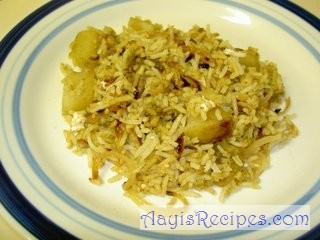

2-3 years back I did not know the difference between biryani and pulav. I thought biryani has a different masala called “biryani masala”, but the method for both are same. We were in San Diego for a small business trip and one of my colleagues always prepared biryani on the similar lines as pulav. It definitely tasted great. But then, our manager (who is a Gujrathi but settled here in US), always said ‘what you people make cannot be called biryani’. I never got any chance to see how he makes biryani. But when I returned to India, I went to Belgaum and made sure to learn the biryani from my Pachi’s cook. Her biryani is just amazing.
Here I’ve noted down tips and tricks on “How to make Biryani / Biriyani”, detailed description and step by step pictures/photos with instructions.
While cooking biryani, the rice is cooked separately and alternative layers of vegetables/meat and rice is arranged and cooked on a very low flame for a long time. The best biryanis have each grain separate. They tend to be more dry compared to pulavs. Read here for more information about biryani. Biryanis can be broadly classified in two – Kutchi(raw) biryani – where the meat/vegetables are layered between semi cooked rice. For ex: Belgaum style biryani . – Pakki(cooked) biryani – where cooked meat/vegetables are layered between semi cooked rice. For ex: Biryani with ‘biryani mix’
As I said earlier, biryanis have 2 or more than two layers of meat/vegetables and rice. But I have noticed that, the biryani cooked in Belgaum has only one layer of raw meat/vegetable at the bottom. Then there are layers of rice topped with biryani masala, fried onion. This may be what they followed from generations, but I absolutely love this. It is possible that to cook the meat fast and evenly they put only one layer so that the rice gives the desired weight to cook it faster(thats just a guess).
Here I give some general steps of making biryanis. I will not give any recipe, because these steps are useful with any biryani recipe.
– Cook basmathi rice with water, salt and 2 drops of oil till rice is 3/4th done. A few whole spices are usually added while cooking the rice. Note that rice should NOT be completely cooked. Drain water from the rice and if required, run it through cold water to separate the grains.


– Prepare the masala, for the ‘kutchi biryani’, fry all spices and meat/vegatetable in oil till a nice aroma comes out. Do not cook the meat/vegetables completely. For ‘pakki biryani’, fry the spices and meat/vegetable in oil and then cook it till the meat is completely done.


– Heat oil and fry onion slices till they turn brownish. Take out the onion from the oil on a paper towel.


– Soak saffron or the biryani color in warm water.
– Divide the meat/vegetable mixture in 2 or more portions. Divide the rice in same number of portions.
– Take a thick bottomed pan and heat ghee/oil. Add one portion of the meat/vegetable mixture. Cover with a layer of rice. On top of rice spread a layer of fried onion and soaked color/saffron (Some people add the onion and color layer only on the top). Arrange all the meat/vegetable and rice layers. Spread fried onion and color on top. If desired, spread a table spoon of well beaten yougurt/curd on top.


– Add some(around 1tbl spn) ghee/oil on top, add 1 cup of water(for 1 cup rice). Cover well and cook on a very low flame. After some time, when the grains have almost cooked (the grains would have become bigger). Heat a tava and keep the biryani vessel on the tava. Cook on a low flame again till the meat/vegetable and rice is completely done (if required, add only a little water, too much water makes the biryani mushy).

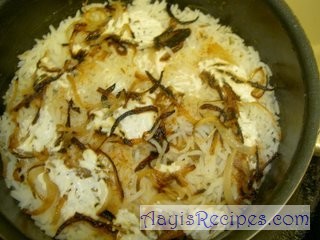
– Serve hot with raita or mint chutney.
PS : Do not try making biryani in a hurry. It comes out great when it is cooked on a low flame for a long time. Do not use cooker for making biryanis. In the above pictures, I have spread some biryani masala along with fried onions and have not used the color. I used the extra masala for the extra flavor. The two recipes where you can follow this method are this and this .
