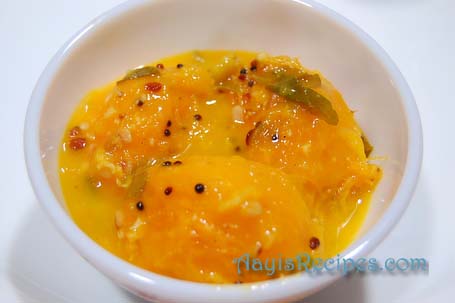
Ambe (mangoes) must be one of the most loved fruit during summer in India. Konkanis make many different dishes with it. One such dish which has a distinct Konkani stamp on it is Ambe humaNe or ambe upkari .
There are many varieties of mangoes grown at our native which are not known to other parts of India. Most of these types are local ( ganvti ). Usually these mangoes are very sweet and have lot of pulp. They cannot be cut with a knife(these varieties are called “ ghonta ” in Konkani) because they have quite big seed( gorto ) in them. So eating them is a messy business, but who cares when it tastes out of the world. The smallest variety among such type of mangoes is used for this dish. It is a spicy and sweet dish. Many times, over ripe or not-so-sweet mangoes are used because the addition of jaggery and green chilies, gives them a unique taste. It is a very common dish during mango season.
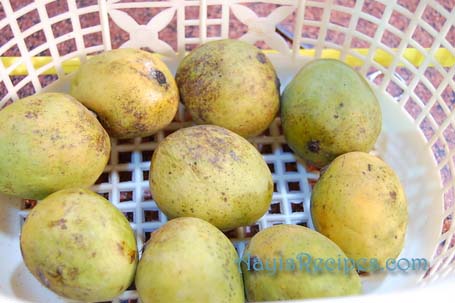
It is a bit tricky to eat this, and I think, the best way is to use your hands. The mango juices absorb all the flavors from the seasoning and it turns into an amalgamation of myriad tastes. Beause these small mangoes are not available here in US, I use mango pieces when I make this here. It tastes great too. But if you ask a Konkani person, we would say, humaNe should be made with these small mangoes and if you make it without them, then it is not called humaNe :).
Ingredients: 7-8 small mangoes 4-5 green chilies 4-5 curry leaves 1 tbl spn fresh/frozen coconut 1/2 tea spn mustard seeds 1/2 tea spn urad dal 1 tea spn jaggery (optional) Oil Salt
Method: Peel the skin of all mangoes. Usually these mangoes have a very thin skin and they come out easily.
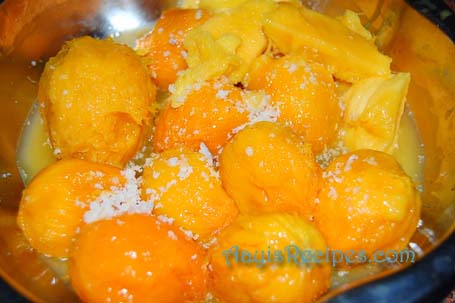
Heat a little oil and add mustard seeds. When they start popping, add urad dal . Add curry leaves, green chilies slitted into two. Now add the mangoes, jaggery, salt, half cup water (if there is not enough juice in mangoes), coconut. Close the lid and cook for 5-6 mins. This helps the mangoes absorb all the flavors and thicken the juices. Serve hot as a side dish with rice and some spicy gravy.
Serves : 3-4 Preparation time : 15mins
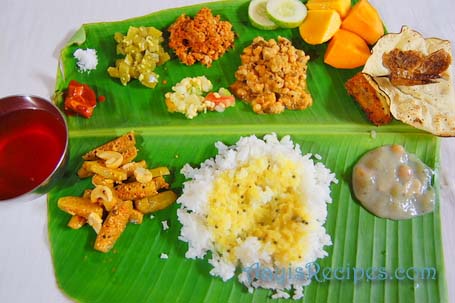
It’s an ultimate feast for the eyes, and a hungry pet (stomach).
Eversince the inception of Aayi’s Recipes, I wanted to post a traditional Konkani thali here. But somehow could not manage to post it. First of all, whenever I cook, I try to make only 2-3 items as it is almost impossible for me to finish off leftovers. So I had to wait till I got back to India to do this. When I was at home, I was a bit hesitant to ask aayi because I didn’t want to pester her with my foodie ideas. But it looks like she knew what I had in my mind, and she said she will cook a traditional feast for me :).
So we decided what we will be cooking. Aayi told me about 4-5 items. I promised her to help her in cooking. The previous day I stayed at my in-laws’ place. Considering the places are just 11km apart, I told aayi that I will reach home early morning and will help. But next day, we got a call from a friend who was visiting Kumta and wanted to meet us. So we had to go there, and then we had to pick up a couple of things. It was already 11 and I called aayi to tell her I will be late. She said I need not worry because she had already finished cooking. I got upset because I could not help her. We reached home by 12 PM and I asked her what she had cooked. I could not believe she had made such a huge spread. Everything was so delicious and perfect.
Now coming to the thali , usually in any functions at our place, the main dishes served are rice, dali thoy (Konkani traditional dal ), one or two kinds of coconut dishes( randayis ), upkari with different vegetables, pickle, phodis , fruits, papad , a sweet. In all the functions, food is served on banana leaf, although these days people are switching to steel plates.

There is a particular way of serving food. – The narrow part of the banana leaf( Suuv ) always has to be on the left hand side. – Salt and pickle are served at the top left corner. – Sometimes when the leaf is small, another small leaf( cholko ) is attached on the top. – A spoonful of sweet is served on the right hand side. – In NK , 99% of functions include dali thoy and muga moLe randayi . Sometimes kolmbo replaces dali thoy . But as far as I know, muga randayi is not included in all the functions in SK .
Usually food is served in 3 courses – In the first course, all the side dishes are served with rice and gravy (usually dali thoy ) – Second course is usually sweet dish, even though a little sweet dish (any paays or kesribhath ) is served in first course, more of the same dish is served in this course. – Third course is normally called taaka (buttermilk) sheeth (rice). Here rice is served with buttermilk.
Kokum kadi is usually optional. But during kokum season, it is usually served.
Below are the list of dishes on the thali

– Salt – Instant mango pickle ( karmbi nonche ) – Snake gourd side dish ( padvale upkari ) – recipe coming soon. – Moong dal kosambir ( muga dali kosambari ) – Raw jackfruit side dish ( kadgi sushal or kadgi chakko )

– Sprouted moong side dish ( muga moLe randayi ) – Cucumber – Mangoes – Urad papad – Fried buttermilk chilies ( taka mirsang ) – recipe coming soon – Fried green chili fritters ( Mirsangi vadi) – Banana fry ( kele phodi )

– Kokum kadi – Ivy gourd – cashew sidedish ( tendli bibbe upkari )

– Rice – Ghee (it got melted, so cannot be seen in the picture) – Konkani dal ( dali thoy ) – Bottlegourd sweetdish ( gardudde paays )
