
Every Indian cusine has its own recipe for this dish. I have been reading about this (‘Baingan ka bhartha’) in many blogs now. So I thought of posting the Konkani recipe of this dish.
At my native, we never had electric boiler to heat water for bath. Instead we have a big iron vessel where water is heated (the vessel is called ‘bhaan’). Dry wood is used to heat water (the arrangement where the fire is put is called as ‘bhaana ranni’). So at the day time, mom used to make smoked eggplant by carefully frying the eggplants in this ‘bhaana ranni’. But as time passed, this method became obsolete. Though people still use this arrangement to heat water, nobody actually uses it for frying eggplant.
I have seen some people who directly keep the eggplant on stove to smoke it. But the problem with this method is, when egg plant is fried, the water starts falling on the burner. So what is the easy way? I felt Pachi’s way as the easiest one. Apply some oil to all sides of eggplant. Keep it on a hot tava and close the eggplant with a vessel and heat the tava. After every five minutes or so, just check if the egg plant is cooked, if yes, turn it. It takes around 10mins to smoke a big eggplant.
This bharth is usually served along with urad-papad (which are very very famous in North Kanara and called as ‘udida happal’ in Konkani. These papads have a strong asafoetida smell) as a side dish with rice.
Ingredients: Eggplant 1 big Coconut 1/2 cup Green chillies or red chillies 3-4 Tamarind 1/2 tea spn Asafoetida a pinch Salt
If the eggplants available in India are used, increase the number. After smoking, atleast 1 to 1 and 1/2 cups of pulp should remain.
Method: Smoke the eggplant as explained above.

Remove the skin.
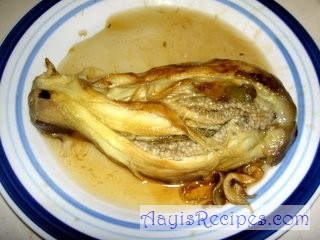
Grind coconut, chillies, tamarind, salt and asafoetida adding very little or no water (since eggplant has a lot of water in it, do not use more water while grinding). Mash the eggplant with hand and mix it with chutney. (Aayi adds the eggplant directly to mixer/blender before removing the chutney and grind just for one round. Eggpant should NOT be ground completely).

If red chilli is used, raw onion pieces are added to this bharth. Serve with urad papad.
Serves : 4 Preparation time : 20mins

Sabudana Khichdi
Sabudana or tapioca or pearl sago khichdi is not very famous among Konkanis. The only Konkani dish with sabudana, which I can recall, is sabudana paays . Though many people prepare this dish these days, this cannot be called as a Konkani dish. I ate it first time at my friend’s home in Belgaum. My friend’s ajji (grandmother) used to make the best khichdi during the fasting days. I simply loved the dish. I asked her the recipe for it, though she gave me exact instructions, I had never tried making it until I went to Bangalore.
In Bangalore, I didn’t find this dish anywhere or rather I did not explicitly search for it. But when I found a sabudana packet in ‘Food World’ supermarket, I thought I will have to give that a try. I recalled her saying, sabudana has to be soaked in water for overnight. So I soaked it for overnight and the next day I found white water instead of sabudana. So I concluded that there was something wrong with sabudana!!!.
After that unsuccessful attempt, I started soaking sabudana for just 30mins or so before making this dish. But somehow I thought it may not be completely right. Then last week Aruna sent me this recipe. The method of preparation was quite similar to ajji’s. Then again she sent me one more mail, stressing on the soaking part. She said ‘Sabudana khichdi prepared by using this procedure tastes great even if it is taken in lunch box. It does not become rubbery’. Still it didn’t flash to my mind.
I thought of giving it a try one more time, so I soaked sabudana in the night. All the time I was thinking of giving proper instructions about soaking part, but something in my mind told me I am doing it wrong. Then at once it striked me. Aruna had told me to soak it for 30mins, then drain the water from it and leave it for 8 hours!!!. I guess thats what ajji had told me, but I had missed the draining part!!!. So next day morning, I found the nice looking, soft sabudana, and the khichdi came out superb. Thanks a lot Aruna , for those instructions. I will read the recipes more carefully hereafter.
Here is Aruna’s recipe for sabudana Khichdi. She said, ‘In Maharashtra it is served with sweet dahi in restaurants. I have never seen or eaten it with any chutney or sev. At my place I like it plain’.
Ingredients:

Sabudana Khichdi
Ingredients
- 1 cup Sabudana
- 2 potatoes boiled
- 1/2 cup roasted peanuts remove the skin
- Oil
- 1 tea spn mustard seeds optional
- 1 tea spn cumin seeds jeera
- 2 green chillies
- 4-5 curry leaves optional
- 1 tea spn sugar
- 2 tbl spn coconut grated
- 1 tbl spn lemon juice or as per taste
- Salt
Instructions
- Wash one cup of sabudana in water. Soak sabudana in water and keep the same for 30 min (not more) After that drain the remaining water and keep it for 8 hours.
- Cut the roasted peanuts into small pieces. This can be done in a mixer but the powder should not be fine, peanut pieces should be felt while eating the khichdi.
- Cut the boiled potatoes into small cubes.
- Heat oil in a pan and add mustard(optional), when it starts popping, add the jeera, green chillies and curry leaves(optional).
- Add the potatoes, salt, sugar and mix well .
- Add the sabudana, mix well and cook on low flame for 5mins.
- Now add the peanut powder and the coconut. Cook for 1min.
- Serve with lemon or squeeze in lemon juice.
Notes

