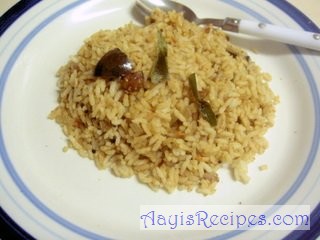
Vangi-eggplant, bhath-rice is probably one of the most popular rice items in Maharashtra and few places in Karnataka and Andhra. I say few places because it is not very common at my native (which is in Karnataka) but I have seen this a lot in Bangalore. I have seen most of my Andhra friends preparing this dish, so I guess it is popular there also. But the Marathi name suggests it might be originally from Maharashtra.
Everybody has their own spice mixture for this dish. I always used the store bought “Vangi bhath masala” and prepared this. But when I tasted my friend Poornima ‘s Vangi bhath, I just loved it (considering I am not a big fan of eggplants). Few days back I asked her for the recipe along with the “Vangi bhath masala” and prepared it. Now I prepare it once in a week for lunch. I have prepared a big batch of masala and making the vangi bhath with ready masala takes hardly 15-20mins. I have become a huge fan of this dish now.
Have a look at the methods followed by few of my food blogger friends: Manisha , Vineela , Mandira , Pavani , Asha .
Vangi bhath masala: Chana dal 1 tbl spn Urad dal 1 tbl spn Moong daal(yellow) 1 tbl spn Coriander seeds 3/4 tbl spn Cumin seeds 1/2 tea spn Cinnamon 2″ piece Cloves 5-6 Red chilies 7-8 Oil 1/4 tea spn
Roast all the spices (except chilies and cloves) one by one on a very low flame till they leave a nice aroma. Heat oil and fry the cloves. Take out and in the same vessel, fry the chilies a bit. Powder them all. Store in an air tight container.
PS: According to the original recipe given by Poornima, the masala includes “Moggu” – which looks similar to cloves but slightly bigger than that. I tried searching for it in the Indian store, but could not find it. I don’t even know the English name of this spice, so I replaced it with cloves. She uses different kinds of chilies, some for the color and some for the spicy taste. I had only Byadagi chilies (a variety available in Karnataka). So I just tried with these chillies. You can increase or decrease the amount after trying the vangi bhath yourself.
Vangi bhath Ingredients: Pea nuts 1 tbl spn Chana dal 1 tbl spn Mustard seeds 1/2 tea spn Curry leaves 4-5 Green chilies 1-2 Onion(chopped) 1/2 cup Eggplant(thin long ones) 1-2 Tamarind extract 1/4 tea spn Vangi bhath masala 2 tea spns Turmeric powder a pinch Shredded dry coconut 1 tbl spn Rice 1 cup Lemon juice 1 tbl spn Oil Salt
I have cut the eggplants into small thin pieces to suit my taste (this is what I understood from the description given by my friend). Be careful about the Lemon juice – tamarind. Since both are souring agents, use them carefully.
Method: Cook the rice and keep aside. Take care not to over cook the rice, otherwise it gets mashed after mixing with the spices. Cut the eggplants into desired shapes. Keep the pieces in water. Before using, discard the water.

Heat oil and fry peanuts. Take them out. Add chana dal, fry and take out. Heat remaining oil (take slightly more oil, say around 1 tbl spn) and add mustard seeds. When they start popping, add curry leaves and fry for sometime. Add green chilies, onion and fry till the onions turn slightly brownish. Add eggplant pieces and fry for sometime. If required, sprinkle very little water, close the lid and cook. When the eggplants are done, add tamarind, salt, vangi bhath masala, turmeric powder, dry coconut and mix well. Take off the heat. Add rice, lemon juice, fried peanuts and chana dal and mix well.

(Do not garnish with coriander leaves).
Serves :2 Preparation time : 20mins

This chutney is known as “kushil narla chutney” (kushile-spoiled, narlu-coconut). Yes, it is basically made of a bit smelly coconuts, not the completely rotten ones though. Sometimes when the coconut is kept as it is for many days, they get a bit of smell (you can smell it, but cannot see the change in color). Instead of wasting such coconuts, they are paired with curry leaves so that the smell can be overcome by a strong smell of leaves. This was how this chutney originated. May be because people were very poor in those days and they just could not afford wasting a coconut. I remember my Aayi telling me that her grand mother used to go in search of a bit smelly coconuts to make this chutney :D.
That was in olden days. But these days we make this chutney with normal coconuts. Once you taste this chutney, I bet you will never ever forget the taste. I am a huge fan of this from my childhood. Few people eat the raw chutney and few people fry it to preserve it for many days. My dad likes the raw chutney and I like the fried chutney, so we always had two batches of chutneys at home. Once when I was a kid, my Aayi fried it well till some of it turned almost black. So I renamed it as “kushil narla lashil chutney” (lashil meaning burnt) :D.
Unlike any other chutneys which are served with either dosa or idlis or vadas, this is served as a side dish with rice. Never tried it with idli/dosas.
Ingredients: Grated coconut(fresh or frozen) 1 cup Curry leaves 2 big strands (approximately 20 leaves) Asafoetida a pinch Red chilies 5-6 Tamarind extract 1/4 tea spn Oil 1/2 tea spn Salt
I use tamarind extract in all cooking. If normal tamarind is used, adjust to suit the taste.
Method: Heat oil and fry red chilies. Take them out and fry curry leaves till they become crispy(do not add extra oil). Take out and roast the coconut till it turns slightly brownish. Grind all the ingredients together to a coarse paste. Do not add too much water. Serve it as a side dish with rice. If you need to preserve this for few days, take the chutney in a pan and heat it. Keep mixing it occasionally.
Fry till the moisture goes off and chutney becomes completely dry(I forgot to take the picture at this stage. Will post some other time). Remains good for at least a week.
Serves : 4-5 Preparation time : 20mins

