
Pongal has become one of our go-to comfort foods these days. I end up making a simple pongal with rice and moong dal or a simple pej( Congee with red rice ) on many days when I do not want to cook elaborate meals. Some days when I want to make it more healthy, I add some vegetables to it, then it becomes a one pot complete meal (although my family prefers plain pongal, they don’t complain). Few days back, I added some quinoa to it, which turned out pretty good. I served this quinoa – vegetable pongal with our favorite huli gojju .
I used matta rice/peje tandul here because it gives some body to pongal – I had first read about it at Mahanandi and loved the idea. It does not disappear like the normal white rice.
Here is a wonderful article about Quinoa and its health benefits.
Ingredients: 1/2 cup quinoa 1/2 cup red boiled rice /matta rice/peje tandul 1/2 cup moong dal 1 cup vegetables – corn, peas, carrots 1/2 tea spn black pepper 3-4 green chillies A pinch tamarind 1/2 tea spn cumin seeds A pinch asafoetida(hing) 4-5 curry leaves A pinch turmeric Ghee Salt


Method: Wash quinoa in cold water couple of times. Wash rice and moong dal. Keep aside. Heat ghee and add cumin seeds, green chillies, pepper, curry leaves. Fry for min and then add asafoetida. Add the vegetables and fry for a minute. Then add quinoa, moong dal, rice, salt, turmeric fry for another minute. Now add 4-5 cups of water (start with 4 and if you want it more watery consistency, add one more). Cook till rice and vegetables are done. I normally cook it in rice cooker. Serve hot with your favorite sidedish.
Serves : 3-4 Preparation time : 45 mins
PS: If you do not find quinoa, leave it out and follow the remaining recipe.

In the last few years, we have tried to document different festivals that we celebrate along with recipes that are very close to us. Here is one very important celebration which is very important to us.
Monsoon marks the beginning of many festivities in our part of the country. With pouring rain, we can see beautiful greenery everywhere in the beautiful Konkan coast . This also marks the beginning  of Shraavan month (maas) . Married G.S.B. ladies celebrate Choodi pooja on all Sundays of this month every year. Shraavan is the most auspicious month for us. This pooja is a pooja of nature and the Sun god. It is firmly believed that it satisfies the Sun god and the nature. It is an occasion where pooja is done in every home and then the choodi is offered to other married ladies in the community. A choodi is a bunch prepared with different plants and flowers.


While forming the choodi (bunch) we use many plants and flowers which are easily available in this season in the garden. Everyone uses different plants/flowers in their choodis. Here I am going to specify the ones I use. These are named differently in different places by people. We use the following plants, these all are local Konkani names – dhirmankur (durve or garike), maad, Sita chavari, vaganangut (majra nangut), aarati, mandri, amshe phool, udka dentu, paarijaat leaf etc. We also use different flowers in the choodi. Some of them are paarijaat, tera phool, ratnagandhi, karaveer etc. All these plants are said to have medicinal values.


We bring all of them together to form a bunch which is called as choodi. These are tied in paarijaat leaf. We usually form fifteen choodis. Choodi is offered with paana veedo(veelya – betel leaves and areaca nut ).
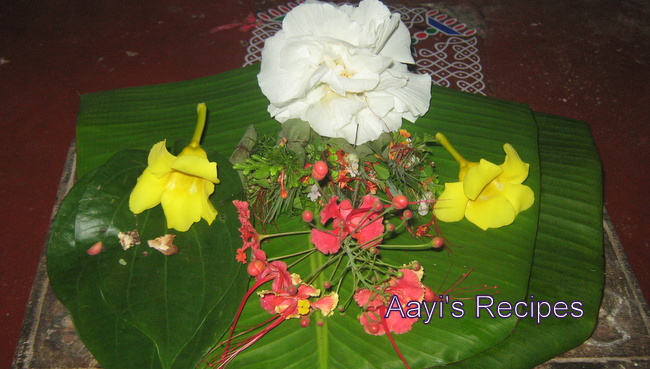


Here is how I celebrate choodi pooja. Everyone has their own ways depending on what they have been following for generations – On Shravan Sunday, after taking bath, I keep these choodis on two banana leaves in our devakoodi(god’s room) after applying gandh(sandlewood paste), turmeric paste and kumkum. I decorate these choodis with flowers. Some people prepare some sweets for naivedya(offering). We were using sugar and ghee earlier. These days I use only fruits for naivedya. I worship choodis with agarbatti(insence sticks) and aarati. I offer akshatas(rice mixed with kumkum) to these and pray to god. After pooja , I take them to Tulsi vrindavan/katte infront of our home. I worship them again, do pradakshinas to Tulsi and offer aarati and akshatas to Sun god. I pray the Sun god and nature. I offer choodi to Sri Tulsi, Sun god, kalpavriksha (coconut tree), jaladevata (water well) and main door (hostilu). I offer to Kuladevata(family god). After wearing it myself I offer them to elders in the house and distribute them to other married women in the community.
