
Deepa sent me this delicious recipe. It is one of the tastiest prawn dishes I ever had. I thank her a lot for sendng me this. I prepared this dish for a small house party, all the dishes I prepared were Goan. Needless to say, everyone liked this dish and it got over within 2mins :D.
Following is some information sent by her : Balchaun is pronounced as Bal- as in hair in hindi, chaun- As in “Chow” pronounced nasally, like a Chinese dish.
This recipe has Portuguese antecedents but is commonly made on special occasions in many hindu homes. We usually use slightly bigger prawns. As children we would clamor for it very often but becoz it was so time consuming to make, my mother would oblige our requests, only on special occasions. It goes very well with any pulao but we particularly enjoyed eating it with “paav”, which is a crusty, lumpy looking bread usually found in small bakeries in Goa. It is used to sop up all types of curries from “tondak” ( any legumes-coconut based curry) to “shakuti”( chicken and coconut masala). I think you get this particular bread all along the Konkan coast. The origin of this recipe is Portuguese and it’s usually the forte of Catholic cuisine but one of the rare Portuguese dishes also enjoyed by Goan hindus. Goan hindus usually turn up their noses at the use of vinegar in food preparation but for some reason are more forgiving when it comes to “Balchaun”. I must add though that the best “Balchaun” is likely to be found in a Catholic home in Goa :).
PS: Remember to add vinegar sparingly, slowly and to taste, becoz for persons not used to the acidic sharpness of this additive it can be a jolt. And try and use big prawns. In Goa we try and use Tiger prawns but they are probably either expensive here or not available easily. If you want to omit vinegar, go ahead but the authentic recipe does call for it.
Ingredients: Prawns 2 cups Tomatos(medium) 1 cup Coriander leaves 1/2 cup Turmeric powder 1 tea spn Peppercorns 10 Garlics 8 cloves Cumin seeds 1 tea spn Oil 1/2 cup Onions(medium) 1 cup Coriander seeds 1 tbl spn Red chillies 8 Cloves 6 Cinnamon stick 2 1/2 cm Ginger 2 cm. Tomato ketchup 1 cup White vinegar 2 tea spns Salt
Method: Apply tumeric powder and salt to to prawns and keep aside. Grind coriander seeds, red chillies, cumin seeds, cloves, cinnamon peppercorn, garlic, ginger to a fine paste. Heat oil in a skillet and deep fry the prawns till brown. Keep aside. Cut onions fine and fry in the same oil till they become soft. Add ground masala paste and fry until the mixture begins to give off a strong aroma. Cut tomatos into small pieces, add to the mixture in the pan and fry for only a few seconds. Add salt and fried prawns. Cover the pan and cook for 5 minutes. Then add tomato ketchup, mix slowly and well. Add white vinegar and mix well and cook for some time. Granish with coriander leaves.
Serves : 6 Preparation time : 45min
I shallow fried the prawns instead of deep frying to suite my guest’s request to avoid deep fried items. Still the taste was great.
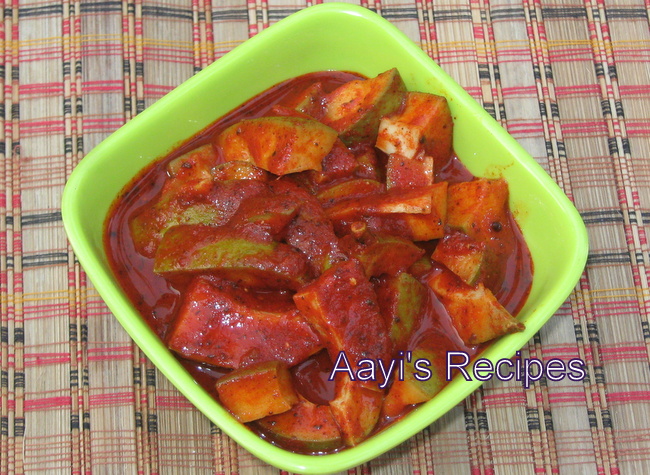
My mother is called as ‘pickle specialist’ by all our relatives. She makes the best pickles I have ever had. The authentic Konkani mango pickle is prepared using the tiny mangoes called as ‘appi ambli’ (ambli – raw mango). It has a long procedure and I am not sure I would make it any time in my life. She uses very very less amount of oil, no artificial preservatives and the pickle remains good for 3-4 years!!!.
‘Karmbi nonche’ is the easiest pickle among all different pickles she makes. The raw mango is cut into bite size pieces and suffiecient amount of salt is added to it. After 1-2 days, the mango pieces absorb the salt, this stage of mago is called as ‘karmbi’ and the whole process is called as ‘karmbuche’. When we were kids, we used to finish the mango pieces before the masala was added to make the pickle :). Ahh..I still remember that taste.
The distinguishing taste of my mother’s pickles comes from generous amount of Hingu(asafoetida). The hing/hingu that we get at our native has very strong aroma compared to the ones we usually get in other places. Authentic recipe calls for ‘Til oil’(sesame oil) in this recipe. But I used vegetable oil and still the taste was superb. Asafoetida granules are better compared to the powder, but if they are not available, use the powder.
This pickle is ready to eat as soon as it is prepared. But usually it tastes better from the next day. This pickle is not very long lasting, because the mangoes loose the crunchiness after few days. So finish it within 15days.
Ingredients: Raw mangoes 2 Salt 1/2 cup Mustard seeds 2 tea spns Methi(Fenugreek) seeds 1/2 tea spn Oil 1 tea spn Asafoetida powder 1/4 tea spn or Asafoetida granules(big sized) 2 Chilli powder 2 tea spns

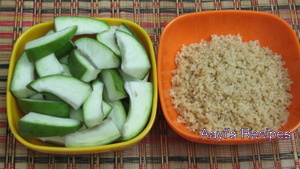

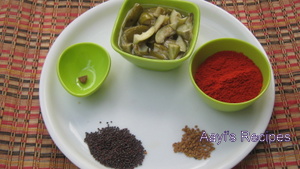

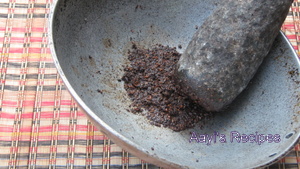
Method: Wipe the mangoes with clean cloth to remove any traces of water. Cut them into bite size pieces and add salt. Keep aside for 1-2 days. Heat oil and fry mustard, methi seeds and asafoetida. When they start popping, remove from heat and grind them (there should not be any traces of water in any of the vessels used to make pickle. Water spoils the pickle soon). Add the ground masala and chilli powder to mangoes and mix well. The first day this pickle should taste a bit salty, if less salt is added, pickle gets spoiled soon. Store in air tight container.
Preparation time : 30mins
