
Ganesh Chaturthi (or Ganapati festival) is a very popular festival in India. A Ganesh idol made of special clay is brought home, wherever they have this tradition spanning generations. There is also public Ganesh pooja popularised by India’s national leader Bal Gangadhar Tilak since the days India’s freedom struggle. I am here to talk about how we celebrate Ganesha Chaturthi at home.
The preparations begin atleast one week before the ‘ Bhadrapada shukla chaturthi ‘ a day on the Hindu calendar which normally occurs in August or September of every year. There are three aspects to the preparation.
Mantapa This is a structure normally made of wood, which is decorated, and the Ganesha idol sits inside this mantapa. Normally in our house, a mantap sits on the frontal edges of a waist height table big enough to host the three halves of the mantap. The mantap’s frontal is decorated with colored, gold/silver type papers and other decorative material. From the top and the corners is provided enough lighting for the Ganesha idol making it appear like its in a temple’s sanctum sanctorum . Also the house’s entrance and doors are decorated with mango leaves and flowers.
PhalavaLi This is an assortment of fruits, vegetables and a coconut tied to a structure in a neat and organized fashion and hung from the top just infront of the mantap. Care is taken that the height of this PhalavaLi doesn’t interfere with people standing below it while performing the pooja .
Food preparations Modak , maande , nevri , panchakajjaya are the most basic offerings to Ganesha. Many people add other sweets to this list as well.
On the day of Ganesha Chaturthi, we go to the Gudigar (or the one who makes the clay Ganesha idol) to whom we’ve ordered to make idol for us as per our liking. Normally we like Ganesha sat on a seat with right leg folded on the left one and colored skinny pink. After giving the price of idol wrapped in panna veedo ( betel leaf with the betel nuts) to the maker, we bring home the idol carefully. At any point in time, care is taken so that no part of the idol gets broken in any way. This is very important. As per tradition, if this happens (Its called ‘ bhagna ‘ -in sanskrit) the tradition of Ganesha pooja at home is discontinued from that year. Before the idol is taken inside the home, at the main entrance, the idol is shown what is called as kumkum water (water mixed with kumkum ) in a copper plate.
Then the Ganesha idol is placed inside the mantapa . Divli , a lamp with cotten threads in oil, is lit from 5 different sides in this. Then as per the Ganesha pooja proceedings, the prana pratishtha is carried out. It means to bring the Ganesha idol to life. There are mantras which go along with different proceedings. Usually this is done by the priest who goes to different homes. But in our place we do it ourselves after the priest instructed us how to perform the pooja . During the pooja all the various offerings are offered along with the meals which consists of dali thoy , rice, mooga randayi , biscuit Ambode (udid vada) , khotto/hittu (idli batter cooked in jackfruit leaf basket) , payasam , pancha kajjaya and various fruits. During the pooja , five different aarti are performed. We play the ‘ Jayadeva Jayadeva Jaya Mangala moorthy ‘ aarti song in the background during the pooja. Ghantaanaad is also done.
After the pooja is over people who are invited as well as the people in the home sit for lunch served on banana leaves. After the Vayasa (meal offering to crows) and Gogras (meal offering to cows), the lunch begins.
Thus pooja is performed twice everyday until the day of visarjana – Ganesha idol immersion in either a well or a lake/river. Normally we keep the Ganesha at home for two days, meaning the next evening the visarjana is carried out. Many Sarvajanika (public) Ganesha are kept for 5 or 9 days. Some even 11 days.
Above Information about Ganesh Chaturthi is writen by my husband. At my parent’s house, we dont have the tradition of Ganesh pooja. We only celebrated Vayna pooja . But at my husband’s house, we have the tradition of Ganesh pooja (After my marriage, I never got an opportunity of attending this festival. So I asked him to write this post). This time we celebrated Ganesha pooja in a very small way here (The proper pooja with Ganesh idol is being performed at my in-law’s place in Kumta). Here is the picture of pooja (we had not planned it before. Just today morning we decided to have a small pooja. So we did it with whatever things available at home).

(From left- Nevri/karjikaayi , modak, dali thoy , mooga mole randayi , Down – Fruits, idli)
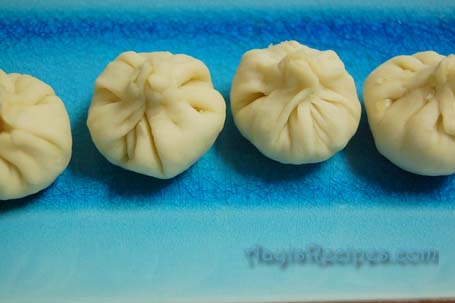
Here is the recipe for most popular dish of Ganesh Chaturthi. I prepared it with my MIL’s recipe which she has been following for years.



Modak
Ingredients
- Outer Covering:
- 1 cup maida
- Salt
- Oil for deep frying
- Stuffing:
- 3/4 cup coconut
- 1/2 cup jaggery
- 1/2 tea spn cardamom powder
- 1 tea spn sesame seeds
Instructions
- Heat 2 tbl spns of oil and add it to maida.
- Mix it very well till all the maida gets the oil.
- Add salt and water to make it a very stiff dough.
- Keep aside the dough for around 1/2 an hour.
- Roast the sesame seeds.
- Heat jaggery and coconut together till jaggery melts and forms a uniform mixture with coconut. Mix sesame seeds well.
- Remove from heat and add cardamom powder. Mix well.
- Take small balls of the dough, roll it into small puris (if the puri becomes too thick, the modaks get a rubbery texture).
- Keep a round ball of stuffing on the puri and cover with the dough to give modak shape.
- Heat oil and deep fry the modaks.
Notes
Note : Reposting the recipe which was posted on Aug 28th 2006.
Modak
Ingredients
- Outer Covering:
- 1 cup maida
- Salt
- Oil for deep frying
- Stuffing:
- 3/4 cup coconut
- 1/2 cup jaggery
- 1/2 tea spn cardamom powder
- 1 tea spn sesame seeds
Instructions
- Heat 2 tbl spns of oil and add it to maida.
- Mix it very well till all the maida gets the oil.
- Add salt and water to make it a very stiff dough.
- Keep aside the dough for around 1/2 an hour.
- Roast the sesame seeds.
- Heat jaggery and coconut together till jaggery melts and forms a uniform mixture with coconut. Mix sesame seeds well.
- Remove from heat and add cardamom powder. Mix well.
- Take small balls of the dough, roll it into small puris (if the puri becomes too thick, the modaks get a rubbery texture).
- Keep a round ball of stuffing on the puri and cover with the dough to give modak shape.
- Heat oil and deep fry the modaks.
Notes

It has been a long time since I posted anything here. Last few months were very busy for us. We were preparing for a long awaited India trip. Time sure flies. Here we are back from India to Kansas now. It was quite emotional trip for many reasons. We had been there after 3.5 years. Since pappa had many health issues in last few months, I wanted to meet him. Just before leaving, we came to know that my MIL had to go through a knee surgery. Thank god, pappa does not need any immidiate medical attention and MIL is also recovering well.
It was Ishaan’s first trip to India. He got adjusted amazingly well there. He is now missing everybody and the big space – at my hometown we have a big front yard, he used to play there all the time. I am sure we all will take a while to get re-adjusted here.
During our last trip, I had spent all my time on taking food pictures. I missed being with parents after coming back. So this time, I did not spend much time on recipes or pictures. I got few recipes from aayi, my sister-in-law and pachi (mom’s sister), which I will post in coming days.
This is a very simple recipe which I often make. This is on the same lines of bhende bharth or vayngana bajji . Usually this is made like gosale bharth or vayngana bharth by grinding coconut. But when I am in hurry I take this shortcut.
Below I have mentioned both the easy version(with pictures) and the traditional version that is made at our place.
Ingredients: 2 cups chopped pumpkin (you can replace with butternut squash) 5 red chillies (for traditional version) or 1 tea spn chilli powder (for easy version) 1/2 cup coconut 1/4 tea spn tamarind extract 1/4 cup chopped onion Salt
Method for easy version: Pressure cook pumpkin pieces(after removing the skin). Cool to room temperature. Add all coconut, tamarind, salt, chilli powder. Mash everything very well. While serving, mix a little salt with onion and mix with the pumpkin chutney. Serve with papad.


Method for traditional version: Pressure cook pumpkin pieces(after removing the skin). Cool to room temperature. Grind together coconut, chillies, tamarind, salt(do not add too much water, it should be chutney consistency). Add the pumpkin pieces to chutney and mash with a spoon. While serving, mix a little salt with onion and mix with the pumpkin chutney. Serve with a urad papad.

PS: It is very hard to cut uncooked butternut squash/ pumpkin. Microwave it whole for 1-2mins and you can cut it easily.
