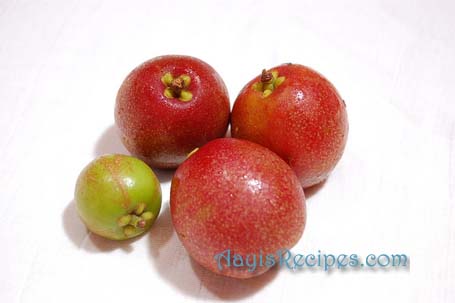
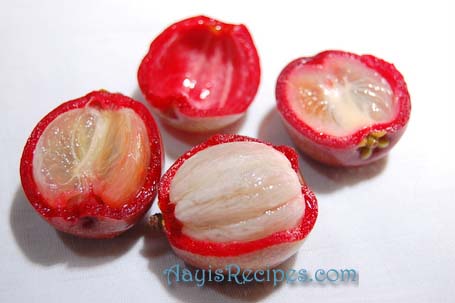
Garcinia Indica or Kokum(called ‘ bhirnda ‘ or ‘ bhinda ‘ in Konkani, ‘ murugala hannu ‘ in Kannada) can be called as one of the most used ingredient in Konkani cooking. Almost every household at our native and Goa has a Kokum tree. I was very lucky to go to India during kokum season this year. So I took the opportunity to take pictures of this beautiful fruit. The seeds of the fruit have a white colored fleshy coating on it. When the fruit becomes very ripe, its color changes to a bit transparent. The inside of the kokum fruit looks like following.
An average kokum tree bears hundreds of fruits during summer. When they are tender, they are green in color. As they ripen, they get the beautiful purple color. The fruits are plucked when they are ripe. The outer purple skin and the inner seeds are sun-dried separately. The skin, bhirnda sol , is used in cooking as a souring agent and the seeds are used to make bhirndel tel (kokum oil/butter).


I have got very fond memories of playing under this tree while growing up. My brother, I and few of our friends would go to our neighbor’s rice mill, which had a big backyard full of mango, cashew and kokum trees. We all would climb the tree or throw stones at the tree to pluck the ripe fruits. We would eat most of it there itself and carry few to home. Another memory which is linked with kokum is of spending summer holidays at my grandfather’s home in Sirsi. A person, whom everyone fondly called as ‘ Adavi raja ‘ (forest king) would come to sell these fruits. My grand parents would buy the fruit from him for us.
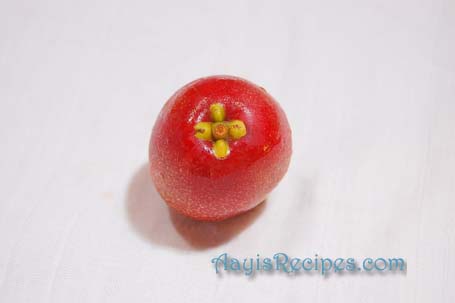
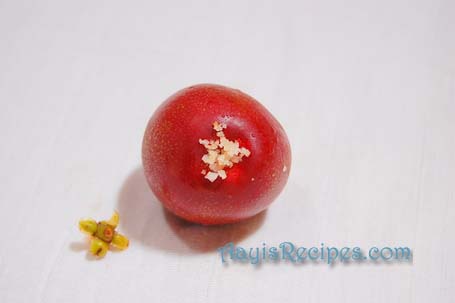
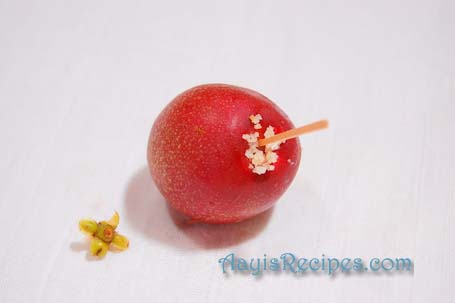
Our favorite way of enjoying the ripe fruit was to eat it with salt. Carefully take out the tiny cap of the fruit, which would leave a hole on the surface. Then with the help of a toothpick, push some salt crystals in the hole. Insert the toothpick in the hole and rotate it few times to mix the salt with the seeds of the fruit. Now suck the juices through the hole. Ahhh..its heaven. Only those who have actually tasted this can understand the sheer pleasure it gives. Once all the juices are done, break the skin into two and pop the seeds one by one in the mouth :). Discard the seeds. This was our favorite fruit to eat(only after mango) during summer vacations.

The most popular dish prepared with fresh kokum at our place is kokum kadi . A sweet, spicy and sour drink with a ingale (charcoal) or mustard seasoning. As kokum has cooling effects on the body, this is the perfect drink for hot summers.
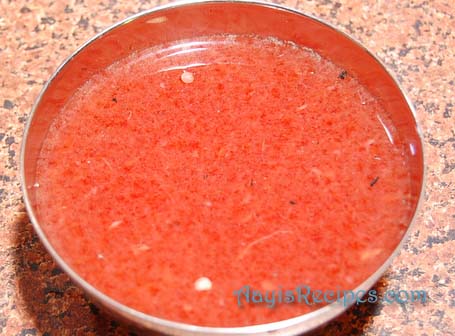
Bottled/canned kokum syrup is available in many shops in Goa which acts as replacement for the fresh fruit to make the kadi . Another version that is very popular is sol kadi , prepared with fresh coconut milk.
The skin of the fruit – which is normally sold as ‘kokum’ is sun dried in large quantities to be used when the fresh kokum is not available.

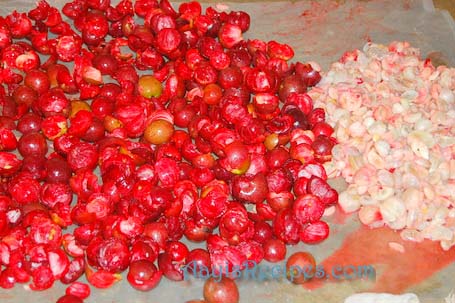
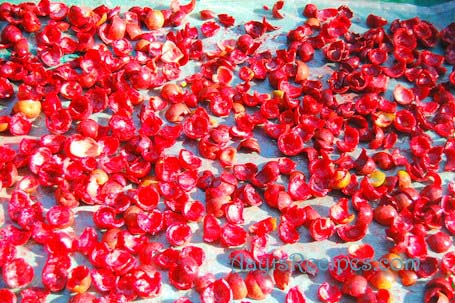
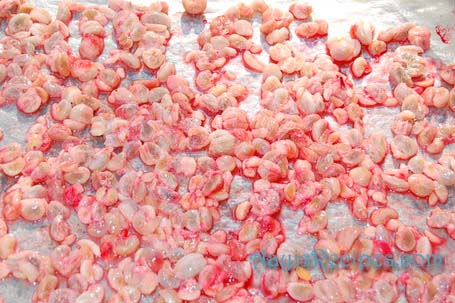
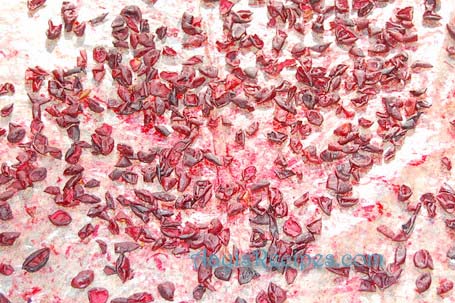
Some salt crystals are added to the dried kokum, which acts as a preservative. As days pass, the dark purple skin turns black. When soaked in water for some time, the skin leaves beautiful purple color. This has many medicinal properties. The skin is soaked in water for sometime and the purple colored water is given to the patients suffering from ‘ pitta ‘.
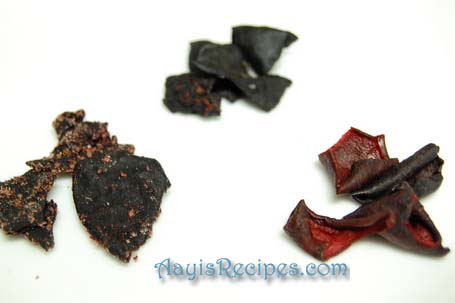
Sometimes the fruit is mixed with sugar and sun dried. The juice that comes out of it is preserved to make kokum juice.
The seeds are sun dried to make kokum butter ( bhirndel tel ). The outer black shells of the seeds are peeled and the inner white colored seeds are chopped and ground into fine paste. Then they are cooked and dried to get the butter. The butter retains its solid shape at room temperature. When needed, it is held near a flame to melt it. This melted oil is applied to cracked heels and dried skin, which acts as a very effective moisturizer. Before we were introduced to different moisturizer brands, we used this as a moisturizer. Even now, we use it frequently for cracked heels.


I have fond memories of Jackfruit ( Panas in Konkani), my pappa and me having a competition to see who eats more. My brother and aayi didn’t like it as much.
Though we loved the ripe fruit and the dishes prepared with unripe tender fruit, we all shared a common dislike for anything prepared with ripe fruit. It must be the the smell that bothered us. So unlike any other Konkani home, where ripe jackfruit dishes were very common, they never made their way to our table.
So when aayi told me she wants to show how pansa bhakri or pansa pathoLi is prepared, I didn’t show any interest. We finished off most of the ripe fruit. But she saved few pieces anyway and prepared this out-of-the-world, absolutely lip smacking dish. The fragrance was intoxicating. She had prepared just two, and we all wished there was more. I finally crowned this dish as the best dish I tasted during my one month long stay in India. This tastes great when it is hot, and topped with a dollop of ghee .
Read the Malayalam version chakka ada . I am sending this to roti mela at Srivalli’s blog.
For covering: 1 cup rice 3/4 cup fresh/frozen coconut 5-6 ripe jackfruit pods Salt
Soak rice in water for 2-3 hours. Grind it with coconut to a fine paste. Do not add too much water. Add the jackfruit, salt and grind again.
For the filling: Coconut Jaggery Cardamom powder
(since all these are added according to taste, I am not giving exact measurements)
Mix coconut and jaggery in a thick bottomed pan and heat till the jaggery is well mixed with coconut. Take off heat. Add the cardamom powder and mix.
Final assembly: Take a banana leaf and apply a very thin layer of covering.

Spread some filling on it.

Either fold the leaf into half, or apply a thin layer to another leaf and cover the first one with it (as I have shown below).


Heat a tava and fry the roti . Since it is sweet, this gets black spots on it very quickly.


Serve hot with ghee .
Serves : 2-3 Preparation time : 30mins
