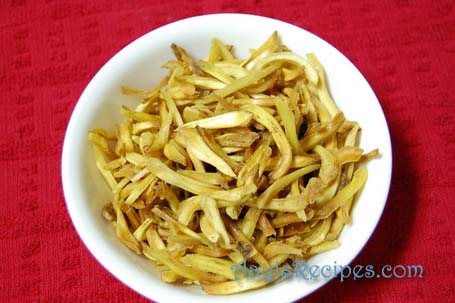
Jackfruit is one of the most loved fruits at my place, ranking second after mango. During season, both ripe and unripe fruit is used in many different dishes. The edible part of the fruit is called ghare (Konkani) or soLe (Kannada), there must be some English name for it, which I don’t know.
Making these chips is one of the sweet memories of my childhood. Raw, but firm and fresh jackfruits, just out of the tree, are used for this. The fruit needs to be completely grown and have firm and thick flesh.
First of all, coconut oil is applied to hands and all the knifes which are used to cut these, since they have a lot of gum. To stop the gum falling on floor, newspapers are spread on ground. It was a painstaking process to take out the pieces off the skin- The innermost white portion ( mav in Konkani) and the outermost thick, rough skin( sali in Konkani) with some white portion is removed and discarded. This helps in easy removal of the edible pieces. Now the big firm pieces are removed carefully. The pieces are cut in long pieces and the seeds are discarded. These long pieces are the ones used for chips.
I am not sure how much the last paragraph will help anyone visualize the whole process. I could not find jackfruit suitable for this anywhere here. So I am not able to upload any pictures. When I go to India next time during jackfruit season, I will surely click pictures of it.
My grandfather would search such jackfruits from our yard and aayi would prepare these amazingly tasty chips. These were prepared in large batches. My brother and I would finish almost half the batch when aayi used to make this. We loved the taste of hot chips. She used coconut oil, so the shelf life of these chips was quite high.
Ingredients: Jackfruit cut into long pieces (pieces should be very firm) Oil Turmeric powder Salt
Method: Mix 3 tea spns salt, 1/2 tea spn turmeric with about 1 cup water and keep aside. Heat oil and deep fry the jackfruit in it. When it is almost done(you can say this by the sound. Initially when the pieces are not fried, you won’t get any sound, as they get fried, you can clearly hear the sound when you mix the pieces with a spoon), pour 1-2 tea spns of the salt-turmeric water in it. Fry till completely done.
PS: – The amount of salt water to be added can be adjusted only after tasting the first batch. As time passes, the oil retains some salt and becomes really salty. So keep tasting it to check correct taste. – When the salted water is added to hot oil, oil splashes out and makes a huge sound. So make sure to stand away from the stove. – After taking out, when the pieces are still hot, a tea spn of chili powder can be sprinkled on it, for extra taste.
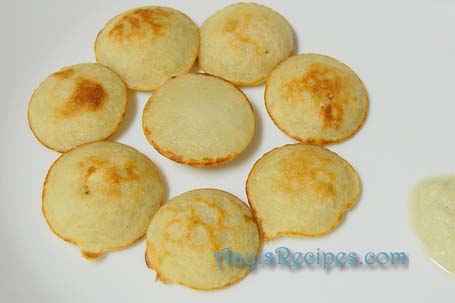
2 years ago, when I posted the uDida appe recipe , I promised I would post this version with kabba (sugarcane) rosu (juice). But one or the other thing kept me posting this. I can’t believe it took me so long.
PaDDu (Kannada), appe (Konkani), ponganalu (Telugu), paniyaram (Tamil), unniyappam (Malayalam), is one of my all time favorite breakfasts. While growing up, these sugarcane versions were prepared only during season when someone who grew them gave the juice to us. These are grown only in few fields and the juice is used to make sugar. Two things which were staple when we got the juice was this one and a special chakli . We also liked to drink the juice spiced with ginger, lime juice and green chilies.
Luckily we have an Indian grocery store nearby which serves fresh sugarcane juice. They usually spice it up, but I always take pure juice to make this appe . My parents brought a nice feather-weight appe kayli (the pan in which these are made) and I have been making these or the other simple appe very frequently. I love these non stick pans because I use only a drop of oil in them (for taste). These can be taken out from the nonstick pan so easily. I also love the aluminum version that I had in India. Traditionally cast iron pan is used and people say the appe made in the cast iron pan tastes great compared to those prepared in any other kind of pans. I never felt any change in taste so far. I don’t prefer the cast iron pan because the batter sticks to the pan and to avoid sticking, we need to add a lot of oil. I have seen aayi struggling with such pan, she now uses the aluminum version, which gives superb results. So if you can find, buy the aluminum pan which has same thickness as cast iron one..
Ingredients: 1 cup rice 1/2 tea spn fenugreek seeds 1 cup fresh/frozen coconut 3/4 cup poha/avalakki 1 and 1/2 cups sugarcane juice 2 tbl spns jaggery 2 tbl spn cashew pieces (optional) 1/2 tea spn cardamom powder Oil/ ghee Salt
Sugarcane juice and jaggery needs to be adjusted according to taste and consistency.Ghee taste better than oil since these are sweet.
Method: Soak rice and fenugreek seeds for about 4-5hrs. Soak the poha in juice for 5-6mins. Grind this with all other ingredients(except cashew, cardamom and ghee /oil) to a thick batter. Do not add water, if required, add extra juice. The consistency should be of idli batter. Mix chopped cashews in the batter and make appe immediately. Serve with asafoetida chutney or anything you like.
Serves : 3-4 Preparation time : 30mins
PS: The batter does not need fermentation. If left out long, it becomes sour. So if you want to make the batter in the night and use it next day, keep it refrigerated. Sugarcane juice gets spoiled easily. So keep it refrigerated. If it needs to be used after 1-2 days, then boil it and then refrigerate.
