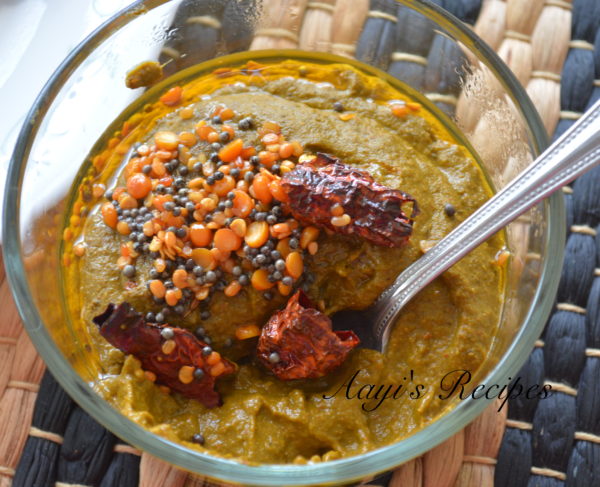
Are you thinking how I started making Andhra dishes? I had some knowledge of it before, thanks to my friends. But it is the food bloggers who gave that extra push.
I always loved Gongura pickle in Andhra restaurants in Bangalore. But I never knew what it is made of, didn’t even know there is a plant called Gongura. After reading about different Gongura recipes, I even tried asking few Indians in a local farmer’s market about this plant (I didn’t know who they were, they might be thinking I was crazy :D). One fine day I saw Gongura pachadi in Arjuna’s blog. She even gave a link of Gongura(sorrel) plant on my request (Thanks Arjuna). Next time I went to Indian store, I could pick up this plant very easily.
There started my experiments with Gongura. I tried the Gongura pappu (I call all the Andhra daals as pappu because I don’t know the name). It was good. But last week, I wanted to make the pickle with it. I picked up a bottle of Gongura pickle in Indian store and read the contents. By the time I reached home it was 10PM, but still I gave a search in google and found this recipe in Bawarchi . I thought this had the similar ingredients as the ones on the pickle bottle in the store. So I gave it a try and it came out just superb.
A bowl of rice with ghee or curd and this Gongura pickle is something I survived on for 2-3 days :D. Currently I am feasting on this pickle, cauliflower pickle , mango pickle, lemon pickle and chili pickle. Mango and lemon pickles are the ones I got from India (Yes they are more than 1 year old but they taste heavenly). Who wants more than that?


Pictorial:
Gongura(sorrel leaves) pickle
Ingredients
- Ingredients:
- Gongura sorrel leaves 4 branches
- Sesame seeds 2 and 1/2 tea spn
- Urad dal 2 and 1/2 tea spn
- Fenugreek seeds 1/2 tea spn
- Coriander seeds 1 tea spn
- Cumin seeds 1 tea spn
- Red chilies 4-5
- Green chilies 3-4
- Oil 1 tbl spn
- Salt
- Seasoning:
- Oil 1 tea spn
- Mustard seeds 1/2 tea spn
- Chana dal 1/2 tea spn
- Urad dal 1/2 tea spn
- Red chilies 2-3
Instructions
- Separate the leaves from branches and fry them and green chilies in little oil till they are tender. Grind them into a paste.
- Dry roast sesame seeds, urad dal, fenugreek seeds, coriander seeds, cumin seeds and red chilies. Powder them.
- Mix the spice powder with the paste. Add salt.
- Heat oil and add chana dal. When it becomes slightly brownish, add urad dal and mustard seeds. When they start popping, add red chilies cut into 2-3 pieces. Pour this seasoning over the pickle and mix well.
- Store in a air tight container in refrigerator.
Notes
Gongura(sorrel leaves) pickle
Ingredients
- Ingredients:
- Gongura sorrel leaves 4 branches
- Sesame seeds 2 and 1/2 tea spn
- Urad dal 2 and 1/2 tea spn
- Fenugreek seeds 1/2 tea spn
- Coriander seeds 1 tea spn
- Cumin seeds 1 tea spn
- Red chilies 4-5
- Green chilies 3-4
- Oil 1 tbl spn
- Salt
- Seasoning:
- Oil 1 tea spn
- Mustard seeds 1/2 tea spn
- Chana dal 1/2 tea spn
- Urad dal 1/2 tea spn
- Red chilies 2-3
Instructions
- Separate the leaves from branches and fry them and green chilies in little oil till they are tender. Grind them into a paste.
- Dry roast sesame seeds, urad dal, fenugreek seeds, coriander seeds, cumin seeds and red chilies. Powder them.
- Mix the spice powder with the paste. Add salt.
- Heat oil and add chana dal. When it becomes slightly brownish, add urad dal and mustard seeds. When they start popping, add red chilies cut into 2-3 pieces. Pour this seasoning over the pickle and mix well.
- Store in a air tight container in refrigerator.
Notes
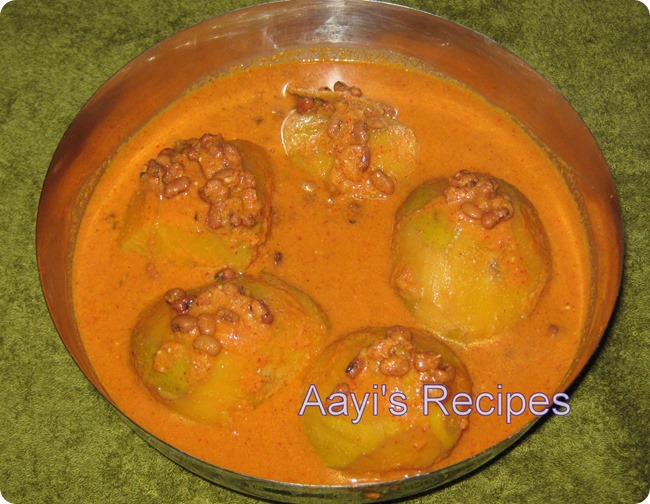
Khatkhate (‘t’ s are pronounced as ‘th’) is a kind of Konkani side dish with coconut masala. Almost 90% of Konkani dishes have coconut in it and they have almost same ingredients. Still there is a huge difference in taste. All the dishes are unique and tasty.
This is one of my favorite dishes from my childhood. This has an amazing taste due to the cooked peas and is a bit sweetish in taste. Usually either a lefy vegetable called “ bhajji dento †along with stem (amaranth) or tiny whole mangoes are used for this dish. Sometimes we include bamboo shoots (keerlu) also in it.
Few days back I had posted a recipe of a dish with sprouted cow peas . There we remove the skin after sprouting the peas. That gets a different aroma after cooking and this dish with the skin gives a very different aroma. You can’t even guess both are made of same peas.
Even when the peas were cooking, I was feeling like eating them. You can’t resist these peas. Since we don’t get either the leafy vegetable or the tiny mangoes here, I used few pieces of mango (along with skin). It was so satisfying to have this dish after so many days. I think I can eat this forever without getting bored of it.
Here is Ashwini’s vegetable khatkhate .
Ingredients: Brown cow peas(bagado) 1 cup Coconut ¾ cup Tiny mangos or Mango pieces 5-6 Kokam pieces(optional) 2-3 Red chilies 4-5 Teppal (Tirphal or Sichuan pepper) 3-4 Salt
Instead of mangoes, the leafy vegetable, bamboo shoots and jack fruit seeds can be used.
Method: Soak cow peas(bagado) in water for 1-2 hours. Pressure cook it (for around 3 whistles). If using the leafy vegetable, jack fruit seeds and bamboo shoots, cook them also in pressure cooker. Grind coconut and red chilies to a very smooth paste. Add the masala to the peas, add mangoes (or mango pieces or the cooked leafy vegetable and bamboo shoots). Add jaggery(if using) and kokam pieces, salt and slightly crushed teppal. Cook for around 10mins. Serve hot as a side dish with rice.
Serves: 3-4 Preparation time: 30mins
PS: – If tiny mangoes are used, remove small portions of skin from 3-4 places around the mango. Do not remove the entire skin. The mangoes should not be very ripe. They should be bit still hard but should be sweet. – Bamboo shoots and jack fruit seeds should not be along with mangoes. They are used only if leafy vegetables are added. – If using the leafy vegetables instead of mango, use a small amount (around ½ tea spn) of jaggery to give a sweetish taste. – If mangoes are a bit sour, no need to use Kokam. If kokam is not available, use tamarind. Teppal is available in few of the Chinese store here, but if you don’t find them, ignore.
Pictorial:


