
These days I am trying to use greens at least once in a week. Because, I find it difficult to do shopping everyday, whenever I buy greens, I have to finish them off in one or two days. Usually I buy spinach, but this time I bought green collard greens . I had no idea what to cook with them, but I was in a mood to cook something new. So I came up with this.
When cooked these in cooker, a very familiar aroma started filling the kitchen. I thought they smell/taste a lot like kohlrabi (navalkol) . Unlike spinach, they don’t become completely mushy after cooking. We loved this dish.
Now about click – A monthly photo event organized by Bee and Jai at Jugalbandee . I haven’t been participating in it even though I wanted to, for a while now :(. Last month, V even clicked a beans picture for it, but I remembered about it only after the last date. This month’s click is a special edition for raising funds for Briana. So far 54% of the amount is collected, still 46% to go. So my sincere request to all of you to please chip in as much as you can, and thanks for the tremendous support you’ve shown so far.
Toor dal is only next to the white rice when it comes to ‘food ingredient priorities’ in our households. These are the pictures of the cooked dal, you can spot the small onion in the first pic. I love all of the following 3 pictures. Let me know which one you like the best.

Update: The above picture goes to click.


Note : Many of my readers who read about ‘click’ asked me if it is a kind of ad program, and we would get some money if you “clicked” on the link. That is not how it works. Please read about the photo event from Jugalbandi.info or from the link in the right sidebar.
Ingredients: 2 cups chopped green collard greens 1/2 cup onion 1/2 cup tomato 1/2 cup + 1/2 tea spn chana dal 1/2 cup moong dal 1/2 cup toor dal Oil 1 tea spn chili powder A pinch turmeric 1/2 tea spn urad dal 1/2 tea spn coriander seeds 1/2 tea spn cumin seeds 1/2 tea spn mustard seeds 1/2 tea spn methi seeds A pinch asafoetida 2-3 kokum pieces Salt
Method: Cook 1/2 cup chana dal, toor dal, moong dal with turmeric in cooker. Cook greens. I used two cooker vessels, placed the dals in the bottom one and greens in top one. Heat oil and fry chana dal , methi seeds, cumin seeds, mustard seeds, urad dal , coriander seeds, asafoetida. Grind to a powder. Heat oil and fry onions. When they are brownish, add tomato and cook. Add dal , greens, chili powder, kokum, ground powder, salt and cook. Serve hot.
Serves : 5-6 Preparation time : 30mins
Update: The first picture goes to click :). Thanks for all your feedback.
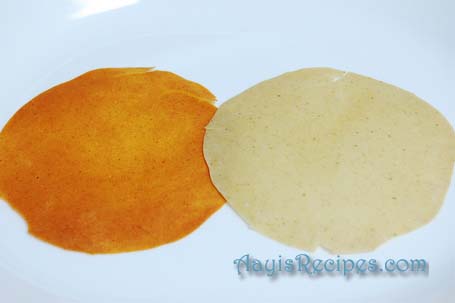
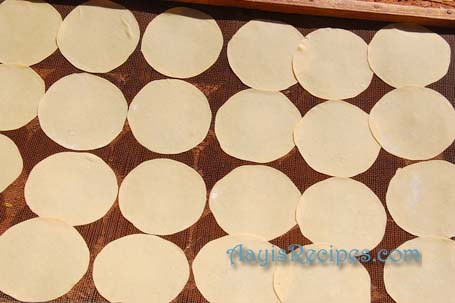
Papad (happolu in Konkani or happala in Kannada) is one of the constituents of Konkani as well as many other Indian meal. There are many types of papads . Banana papad is already on this blog. Jackfruit papads and wheat papads are known to many people. Many people make garlic papads . Making all these were possible in many joint families, because all the women joined hands in carrying out the project. Today I am posting this urad papad which many people make at home though it is a tedious procedure. Due to the availability of many branded papads (like Lijjat papads etc.) and non-availability of the assistance from womenfolk, papad making at home is vanishing slowly. Here and there, we find many women organizations making the papads on a large scale and selling them in the market. But some are still sticking to making them at home as they can get papads as per their own taste and to preserve this procedure for their next generation.
When I came to Kodkani after my marriage, I could not get any assistance from any ladies in my house. My mother-in-law had passed away and my sisters-in-laws were married. My husband and father-in-law were the only two people with whom I could share my views. We were getting whole uradgrams from the tenants. These were measured in kolaga which looks like follows.
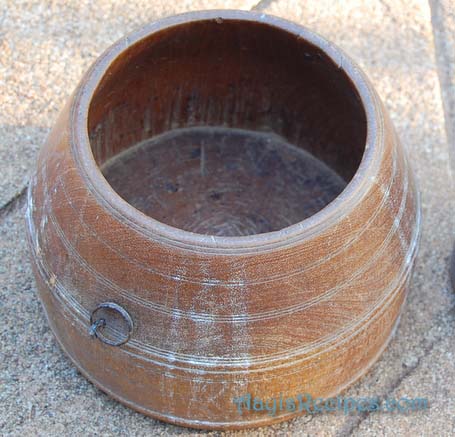

After a couple of years, I started making papads by taking help from neighboring women. Few of them would come to roll papads at our home and in turn Shilpa and I would go to their homes when they made papads . My father-in-law or husband would help in pounding the dough (which required a lot of strength) on hand grinder( ragdo ) which looks likes this –

All the kids would help in spreading them and also making hapli ( papad rolled into small discs). We had many rolling boards(called latpaLe) at home to make just these papads . We would usually make one batch of white(with green chilies) and one batch of red(with red chilies). Many years I have also made it many times to give to our relatives. I stopped making them at home after my children moved away from home. Our neighbor started her own small business of making papads and selling them. So now we buy from her.
Usually two types of papads are made. White papads(dhavve happolu) are made with green chillies and red papads(tambde happolu) using red chilli powder. When same quantity of urad dal is used, we get more number of red papads than green papads . I always use Gokarn green chillies which are mildly hot (I know these are not available everywhere, but still thought of mentioning it) as it gives good colour and aroma.


Sometimes handful of special chilies called as sapur mirsang (thin chilies) are used along with normal chilies to give extra spiciness. Following is a picture of such chilies dried.

Many people like eating the dough before making the papads . Usually small balls of dough(called guLi ) is dipped in coconut oil and this is a very popular way of eating them. The other popular way is nevri . A thin papad with one or more guLi is rolled and some loose urad flour is kept in center. A small well is created in the center and coconut oil is poured in the well. Now the sides are closed. A small hole is left open at one side. The kids would blow air into them like balloon and secure the end and eat them. This was one of the main attractions for kids in the whole papad making procedure. My husband and son both love this till today. Whenever my son visits us, he goes to neighbor’s home to bring nevri .
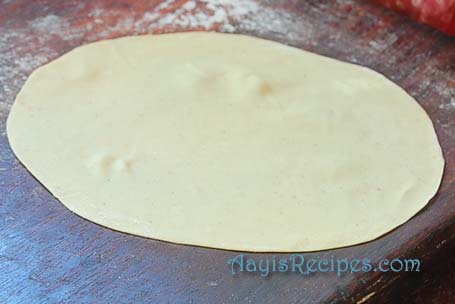

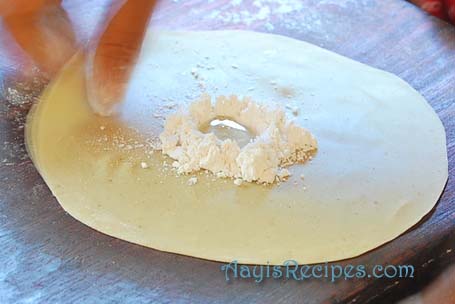


Traditionally, these papads are directly held on the hot stove to roast them(be very careful while doing this as they get burnt easily). Then few drops of coconut oil is sprinkled on them and served. But in large functions, these are deep fried as roasting them on stove takes a long time. They can even be roasted in the microwave.

All pictures of papad making were taken at our neighbor’s home as I didn’t make them in a long time now.
Ingredients: 3 kg urad flour 1 kg green chillies 50 grams baking soda 50 grams papadkhar 10 grams asafoetida 250 grams salt 4 teaspoonful pepper 500 ml coconut oil
To make red chilli papads use 500 grams of red chilli powder in place of green chillies.
Method: Add one teaspoonful of coconut oil to the green chillies and sprinkle some 3-4 teaspoonful of water. Steam boil the green chillies in a pressure-cooker. Cool it to room temperature and then grind it smoothly in a mixer or grinder. Add soda, papadkhar, asafoetida, salt and pepper powder to the paste and grind again.
Take the paste in a big vessel and mix with the urad flour. Leave aside 2-3 cups of urad flour as it is necessary while rolling papads . Add water enough to make it a dough.
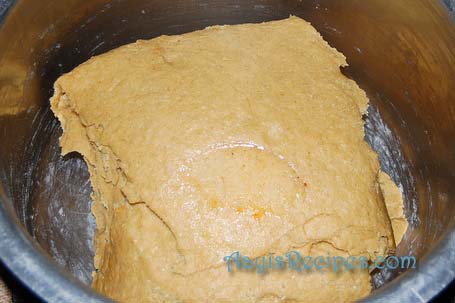
Smear oil to the grinding stone ( ragdo in konkani or oralugallu in kannada) and parayi/haare and then pound the mixture and make 4-5 balls. If necessary use a little quantity of oil while making the balls. Do not add much water to it. The balls should be harder than puri dough. Keep it overnight.
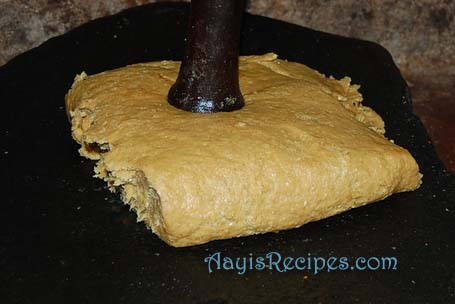
Next day, smoothen the dough by taking small pieces in hand and then kneading it by stretching again and again. Roll into a thick rope, cut into small pieces as in making puris . These are called guLi in Konkani.

While rolling, apply some coconut oil to the balls and then roll. Roll these into papads . The kids would roll them into small discs called hapli .
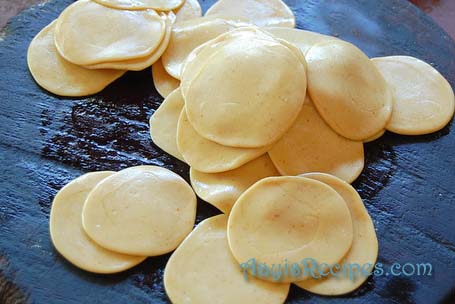

Then the elders would take hapli and make into big papads . This was to take help from kids, but at the same time, keep all the papads in same size, thickness and shape. To help in rolling, loose dry flour can be used).
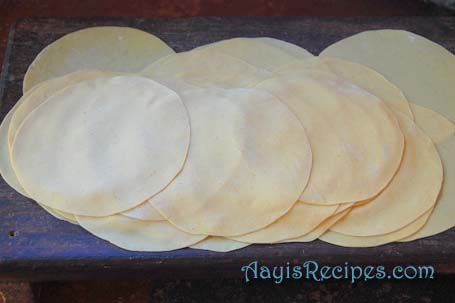
Dry them under the hot sun. Store them in airtight container.
Makes about 450 papads
