
Few days back I had posted Khubbe/Tisre/Kalva sukke , I gave introduction to these three types of clams and where to find them. This gravy is my all time favourite (as I mentioned here ).
I fondly remember my father preparing Kalva ambat when I was a kid and my mother had been to visit my grand mother. I still remember that taste. Usually my mom prepares Kubbe/tisre ambat because this kind of clams are easily available at our native (we have a river called ‘Aghanashini’ near to my home. There are some people who catch these clams and sell it for their living).
I want to send this post to Revathi’s comfort food event , because whenever my mom prepared this dish, I eat atleast double my capacity :). Choosing this entry was a bit difficult, as all the food prepared by my mom is comfort food for me.
Ingredients: Clams 1 cup Coconut 1 cup Onion 1 Red chilies 5-6 Tamarind 1/2 tea spn or Raw mango pieces 2-3 or Bimbal 2 Coriander seeds 1 tea spn Oil 1 tea spn Salt Eggplant(vangi) pieces (optional) 1/2 cup Drumstick (optional) 5-6 pieces
Usually when Khubbe/tisre are used, eggplant and drumstick are also added to make it more tasty. But some people do this gravy without these two also. Also few of the shells are left intact with the meat. Kalva meat is little bigger than khubbe/tisre. For this gravy, vegetables are not used. These are usually found in the stones, so they do not have seperate shells.
Method: Heat oil and fry coriander seeds. Grind them with coconut, tamarind (if using) and red chillies. Heat oil and fry onion. When they turn slightly brownish, add clams fry for a minute, and add drumstick(optional), eggplant(optional) and mango/bimbal (if using). When clams are cooked (it will take about 8-10mins, they shrink in size considerably). Add masala and salt. Cook till masala is done. Serve with hot rice.
Serves : 4 Preparation time : 20mins
Many people had asked me to post ‘how to make soft chapathis and phulkas’. Finally I am here with this post. Those who are expert in chapathi/phulka making, skip this post.
My experience with chapathi/phulka was very bad. When I started cooking, I could never make soft chapathis/phulkas. They used to come out very hard. I still remember one incident that happened in my previous office. There was a bachelor guy, who was very humerous and never missed any chance of pulling my leg. He used to sit beside my desk. One weekend we were working and he said he was very hungry and asked me for my lunch box. Though I warned him about my chapathi, he insisted on eating it. When he tasted it, he said, ‘Shilpa, me isse acha roti bana leta hoon (I can make better chapathis)’. He went on commenting how bad were my chapathis. That was the biggest insult I have ever got. Then he went on telling people about my chapathis. After that I tried and tried and now I can make the perfect soft chapathis.
So here it goes….
Take 2 tbl spoon of water and add 1/2 tea spn salt, add 1 tea spn of oil to make the chapathis soft. Then add wheat flour (1 cup). Mix and gradually add water/flour to make the dough. (Some people make the dough with warm milk to make the chapathi/phulkas soft). Now apply 1-2 tea spns of oil to the dough. Keep it aside for around 30 mins to 1hr.

(Chapathis/phulkas can also be made without milk and oil. But I usually add oil, have not tried milk any time. My mom makes very soft chapathis without oil and milk. She just keeps the dough for around 1hr before making chapathis/phulkas).
Most important thing to make them soft is – Dough should not be very hard – Leaving the dough for 1hr before making the chapathis/phulkas – Frying of the chapathis/phulkas make a lot of difference. So I have taken the pictures of each step. – Do not leave chapathis for longer time on the tava, so use hot tava for frying. – Once fried, stack the chapathis/phulkas one above the other and immediately close the lid. This keeps them hot and soft. The chapathis/phulkas which are down in the stack are more softer. So reverse the stack after some time, so that the topmost becomes the bottommost. This way all the chapathis remain soft.
Chapathi: Usually for chapathi, the dough is made into a small puri, ghee is added in the between and folded into triangular shape and then again rolled to make chapathi. This procedure makes the chapathis more soft. Usually chapathis are more thicker than phulkas(it is not a hard and fast rule).


Take extra care while frying them. Heat the tava to very hot. Then keep the chapathi. Turn it when you can see it fried from down.


Fry on second side then turn and fry.
Then turn again ie, each side should be fried twice to make sure it is fried properly. (At the max turn it thrice, if it is turned again and again, chapathis become hard). Then apply ghee. (Unlike phulka, chapathis are fried completely on tava, but phulkas are fried on tava and then on direct flame).

Phulkas: Roll the dough as thin as possible (no folding).
Keep the tava on hot tava and reduce the flame. When you can see just white patches, turn it (chapathi should be fried as more as possible during each turn, but for phulkas, the side should be fried only a little on tava, see the below pictures).

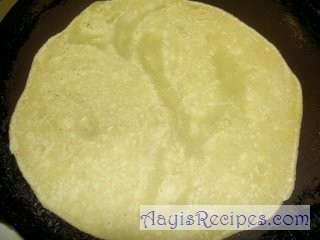
Turn and then fry on the second side.
This side should be fried a bit more than on the first side, it should be almost fried from this side).
Now on a high flame, keep the phulka on direct flame (first side down).

Phulka
Within one minute the phulka puffs. Slowly remove the phulka from the flame.
PS: I normally use 1 cup water to 1 and 3/4 cup to 2 cups flour. This is approximation only. If you feel your dough is too soft and you can’t roll it, add little more flour. I use Pillsbury chukky fresh atta which gives very soft chapathis.
If none of the above things work, try making them like jolad rotti here by cooking the dough. This method is guaranteed to work.
